Showing posts with label the classics club. Show all posts

Tuesday, 17 March 2015

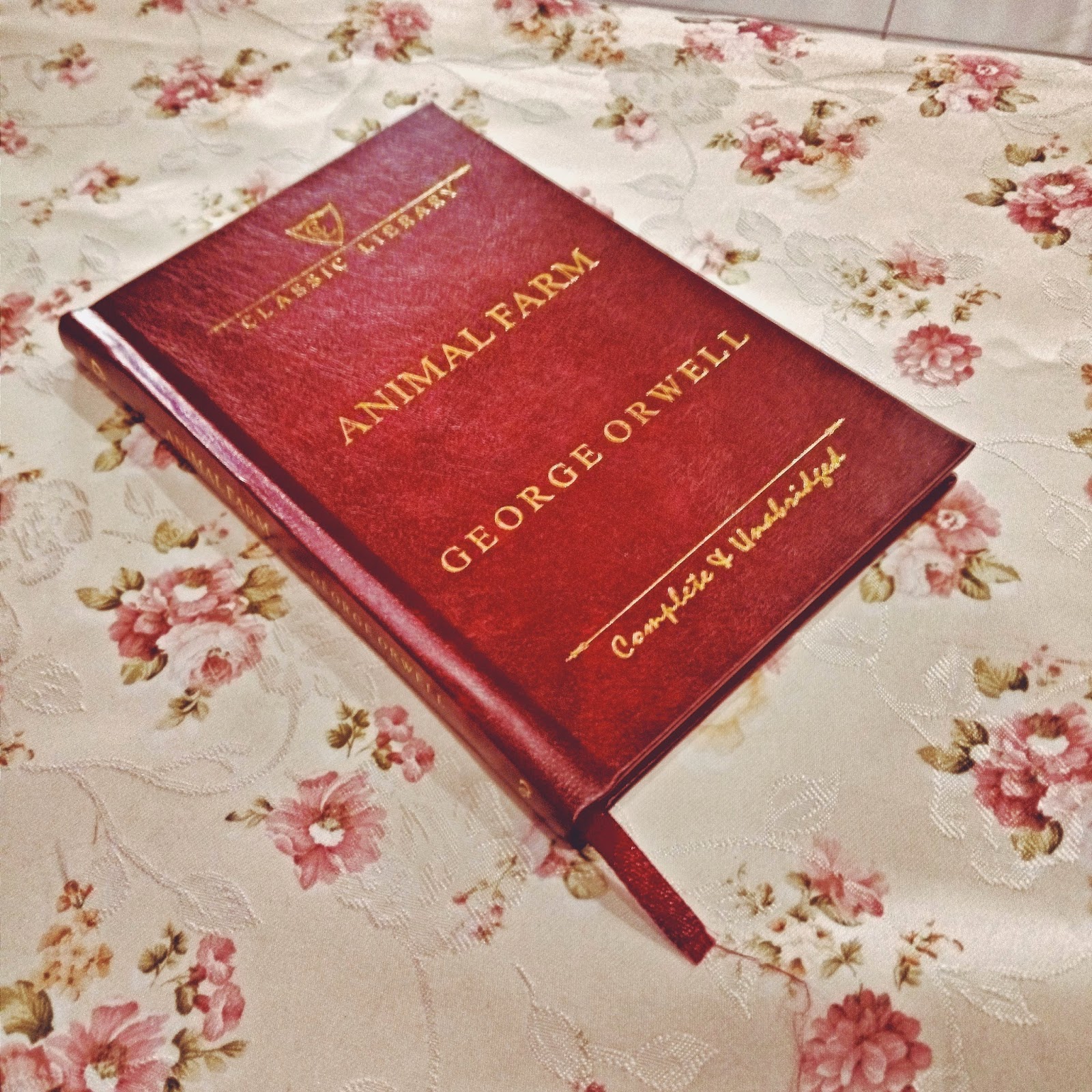
Animal Farm is a book that I’ve seen everywhere—libraries, bookstores, book lists—and it is difficult to fathom now why it take me so long to read it. I’ve also come to associate the picture of pig on the cover as Animal Farm and sorry to say, I had never bother to find out the meaning of the pig. Heck, I’d never be bothered to read the summary of the book. Then, my brother bought the book for me and everything changed.

This is hands down one of the best books I have ever read! It is knowingly funny, deceptively simple, and deftly ridiculing the hypocrisies and twisted logics of Communism (or any known society is more like it). For a simple tale, it makes me think a lot! It speaks to me and holds timeless truths. For example, Orwell wrote this to satire the Stalinism / Communism in Russia, but whoever read this book presently still can see clearly the parallel between Animal Farm and the modern society. The leaders said one thing today and contradicted it the next day. Then there are the people who blindly followed the so called leaders, putting their faith on them, only to be betrayed by these people, such as in the case of Boxer. Then there is people as represented by Benjamin, who despite possessing the knowledge and noticing things, refused to actively participate because deep down, he already sensed the unpleasant outcome. 
“Life will go on as it has always gone on—that is, badly”, he said.

After the rebellion, the animals put up seven commandments on the barn wall as the rules of their newly established society. Yet over time, the rules are amended to the advantage of the pigs until one rule emerged, the now famous: 
“All animals are equal; some animals are more equals than others” 
And then there is the slogan that is constantly shouted by the goats “Four legs good, two legs bad” that changed to “four legs good, two legs better” once the pigs have mastered the skill to walk with two legs. I remember I laughed hard when I read that despite not wanting to because I was extremely disgusted by the pigs behaviour. The diversion from one major issue to a minor one by a skilled manipulator as depicted by Squealer hit too close to home I felt uncomfortable. Orwell’s observation on human behaviour and condition is sadly true and it can be observed on every level of human interactions no matter the classes.

When I read the last word from the last page, I was left with sadness and awe. I’d hope for things to turn out differently, that maybe the animals will find their courage and strength to fight for their rights and subsequently establish an ideal society. Instead, all I got is this: 
“Twelve voices were shouting in anger, and they were all alike. No question, now, what had happened to the faces of the pigs. The creatures outside looked from pig to man, and from man to pig, and from pig to man again; but already it was impossible to say which was which.”

Monday, 16 February 2015

The Wonderful Wizard of Oz by L. Frank Baum


A timeless classic. I went into this thinking that The Wonderful Wizard of Oz would be something that is deranged and unintelligible. Thankfully, I was proven wrong. It turned out to be an excellent children book, simply written, with a lot mishap and excitement to keep the story going. I think I would've enjoyed this book more if I had read it when I was a child.

Throughout the reading, I was struck by how the characters—Tin Woodman, Lion, and Scarecrow—had low self-esteem. Each wanted something that, in my opinion, they already had. Tin Woodman wanted a heart, and yet he appeared to be the most kind-hearted and sensitive of the four. For someone who was heartless, the Tin Woodman constantly burst into tears if sorrow and regret. Scarecrow wanted a brain when he was the brainiest of the gang and always came up with plans that helped them to overcome their obstacles. On the other hand, the Lion who called himself a coward kept putting his life in the front line to protect his friends from the coming perils.  This was extremely contradictory. I kept hoping they would realize this and accept themselves for who they are but the illusion of having courage/heart/brain were too instill in them that they didn’t believe they would be happy without it.

I also liked the incorporation of puns in the text. They got me chuckled a few times. For example, when Oz removed the Scarecrow’s head and filled it with a measure of bran, he then announced that the Scarecrow will be a great man, for he (Oz) had given the Scarecrow a lot of bran-new brains. The Lion’s “That proof that he is sharp.” further alluded to the pins and needles needed to support the Scarecrow new bran-filled head.

One thing I didn't like, or uncomfortable with The Wonderful Wizard of Oz was that it was littered with violence and horrific deaths. The Tin Woodman cut down the wolves’ heads (forty wolves, if I’m not mistaken) in one night, and not feeling a bit of remorse. While the wolves did come to cause them harm, for someone who was as sensitive as the Woodman, I’d expected a less display of savagery. He also cut down trees with no regards whatsoever to them. I was frankly shocked by this. The Tin Woodman’s origin was also grotesque. Cutting down each part of his body one after another and replaced them with tin, that must be extremely painful.


I don’t have much to say about Dorothy. She seemed rather flat character, with a singular goal on her mind. However, she was also the only one who was happy with her lot and recognized her friends’ worth despite their low self-value. Oz definitely was the most interesting character in the story even though he only appeared sporadically in the book. He seemed like an ingenious man who made the best of his situation. He tried his best to help people too regardless of his limitation. So, I, like Dorothy, had learned quite a few lessons from this tale. 

*All original illustrations by William Wallace Denslow.

What is your favourite children classics?

Thursday, 12 February 2015

A Tale of Two Cities by Charles Dickens

Written in 1859, A Tale of Two Cities was published in weekly installments in Dickens’s own journal, All The Year Round. It left its mark on my reading history as the first Dickens that I’d read. They did say this was the less “Dickesian” of all Dickens’ books though. I had tried Great Expectation last year but gave up after 10 pages. So, let’s get on with the review, shall we?

The first 70% of A Tale of Two Cities was a build-up to the climax. While written as a story of the French Revolution, Dickens also explored the human emotions, reactions and interactions with each other. These very humane traits are what have been defining us for ages past and still is. Human suffering doesn’t merely happen during the French Revolution, it has happened long before, is still happening amd potentially will persist for as long as violence and inequity continue to flourish.. Just look at the daily news. Dickens delivered all these by writing alternately from the sides of the Manette, the Evremonde, the Defarges, the Crunchers, Mr. Stryver, Sydney Carton and Mr. Jarvis Lorry. The most interesting story among these was definitely the Defarges whom we can see from miles away would definitely play pivotal role in the revolution. There were lots of foreshadowing in the novel and it was chilling because you know things are going wrong and it is only getting worst. 


Once the revolution started, I confessed I can’t put the book down! I actually cheered out loud once the people finally fought for their rights. However, their leaders—The Defarges, the Jacques, The Vengeance—soon abused their power. They became exactly like the people they’d overthrown; not caring on who they punished and murdered. The customary machinery of oppression—prisons, detention without trial, inequality, the abuse of power, complacency, and arrogance—which originally gave rise to the political revolution were again used to suppress the people. Once La Guillotine was erected, they easily sent away aristocrats and poor innocent peasants alike to the national razor. And far from being merciful to their fellow creatures, the people even invented the mad dance of “Carmagnole” to celebrate the death or the release of the prisoner. This further symbolized the chaos and violence of the crowd. Even Dr. Manette’s position as a former prisoner of Bastilles and respected physician in the middle of the revolution was not enough to overturn the cruel, vile Revolutionary Tribunal.

Despite the dark hours, Dickens inserted moral theme to remind us that only kindliness and virtues brought peace in life. This was evident in his writing of Lucie as an angel—nurturing people with true love and inspiring them to do good in return; in Dr. Manette’s ability to heal and look beyond the past affliction; in Miss Pross’ determination to not back down and fought her way through hardship; in Mr. Lorry’s loyalty to the people he loved; in Darnay’s perseverance through bleak time; and in Sydney Carton who gave his all for the best thing in his life, thus leading him to show the best of him—his comforting of the poor seamstress. I admit I sobbed at this.

Note I: All featured illustrations are by Frederick Barnard from the 1872 edition. 
Note II: On the preface, Dickens wrote that he first conceived the main idea of this story was when he was acting with his children and frieds, in Wilkie Collins’s The Frozen Deep. You bet that’s going to be on my to-be-acquired-pronto shelf.

Have you read A Tale of Two Cities or any book by Charles Dickens?